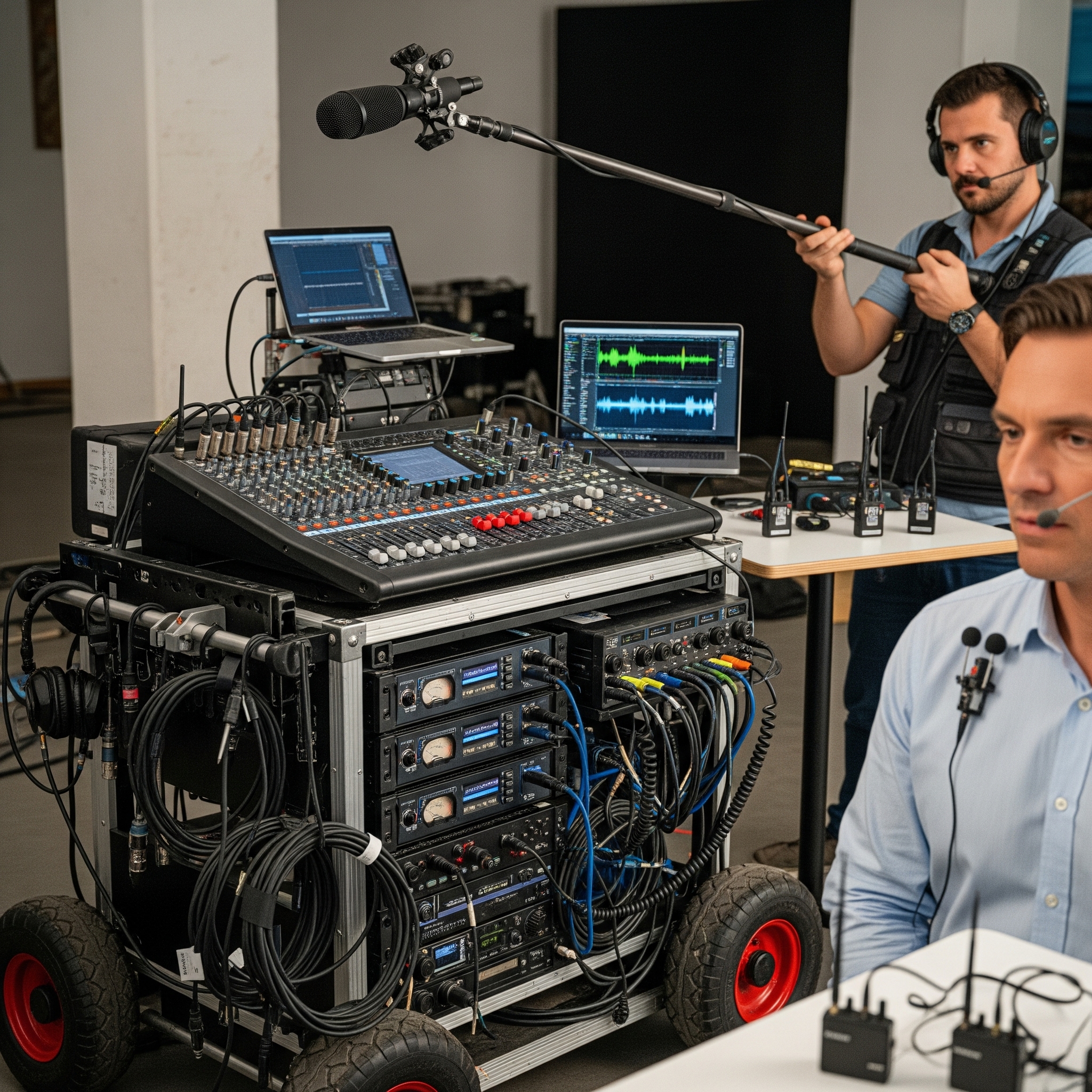
Undoubtedly, we have all witnessed visually arresting videos that are unprofessional in appearance and unwatchable by viewers due to an audible or inaudible soundtrack. In the absence of adequate audio production, sound rental is a dependable and cost-effective substitute that offers access to premium equipment at significantly lower prices than purchasing it.
To guarantee the best possible sound quality for your project, how can you successfully negotiate the frequently complicated world of audio equipment? Let’s simplify things for ourselves and take things one step at a time.
The Essential Gear: What You Need to Rent 🎚️
A professional sound setup has three main parts: a microphone, a recording device, and a way to get the sound from the microphone to the recorder.
This is the first and most important thing you need to capture. The type of microphone you need depends on what you’re talking about and where you are. When it comes to dialogue, you’ll mostly have to choose between a lavalier mic and a shotgun mic.
- Shotgun mics are very directional microphones that are made to pick up sound from a small area in front of them and block out sound from the sides and back. This makes them great for recording conversations from a distance without picking up background noise. They are usually put on a boom pole and held just above the actors, out of sight.
- Lavalier (Lav) Mics: These small microphones clip onto a person’s clothes, usually near the collar, so they don’t stand out. Because they are close to the source, they are great for interviews or scenes where a boom mic isn’t possible. They give you a clear, steady vocal track, but you have to be careful not to make your clothes rustle.
Audio Recorders: Your camera can record audio, but the preamps (the circuits that make the microphone signal louder) are often not very good. A Zoom H6 or Sound Devices MixPre, which are both dedicated field recorders, will give you much cleaner audio. These devices can record more than one audio track at the same time, which is necessary for scenes with more than one person.
You will need a wireless transmitter and receiver system for lavalier mics. This lets the talent move around without a cable following them. For boom mics and wired lavs, on the other hand, you’ll use XLR cables that are made for professionals.
Don’t forget the small but powerful accessories. For a clean recording, you need a boom pole for your shotgun mic, a shock mount to keep the mic from picking up noise from handling, and a windscreen or blimp to keep wind noise out.
Jay Rose talks about how important it is to get good sound at the source in his book Producing Great Sound for Film and Video. He says, “The old saying ‘fix it in post’ is a lie.” You can’t fix audio that is bad. You can only make it less bad. And that takes a lot of work and time.” This episode makes a very important point: nothing can really save a bad recording.
Choosing Your Setup: Budget vs. Quality 💸
Your budget will naturally influence your choices, but it doesn’t mean you have to sacrifice quality. The beauty of sound equipment in Dubai’s rental market is its range, catering to both indie filmmakers and large-scale commercial shoots.
| Budget | Microphone(s) | Recorder | Accessories & Notes |
| Basic | 🎙️ 1-2 Lav Mics (wired) | Basic Field Recorder (e.g., Zoom H4n Pro) | Windscreen, headphones. Focus on getting the mic close to the source. |
| Intermediate | 🎙️ 1-2 Wireless Lav Mics + 1 Shotgun Mic | Intermediate Field Recorder (e.g., Zoom H6) | Boom pole, shock mount, headphones. Offers more versatility for different shots and scenes. |
| Professional | 🎙️ 2-4 High-end Wireless Lav Mics + 1 High-end Shotgun Mic | Professional Field Recorder (e.g., Sound Devices MixPre-3 II) | Blimp/windshield, multiple boom poles, headphones. Full control over every audio channel. |
It’s a good idea to talk to the sound department of film equipment companies in Dubai before you buy anything. They can suggest a complete, curated kit that meets your project’s needs and budget, so you don’t have to worry about putting together your own equipment.
Practical Tips for Flawless Audio 🗣️
- Monitor Your Sound: The single most important rule is to wear headphones and listen to your audio while you’re recording. Don’t rely on the tiny meters on your camera or recorder. Listen for background noise, clothing rustle, or any other issues.
- The “Golden Rule” of Mic Placement: Get your microphone as close to the sound source as possible without it appearing in the shot. Proximity is your greatest tool for isolating your subject’s voice and minimizing unwanted sounds.
- Room Tone: At the beginning of every new location, record 30-60 seconds of silence. This “room tone” is not silence, but rather the ambient background noise of that specific location. You can use it in post-production to smooth out edits and avoid jarring audio cuts.
Poor audio can ruin an otherwise perfect video. Learn how to get professional-grade sound for your projects by strategically renting the right equipment for any budget.
FAQs About Video Production Sound Rental
1. What mistakes do filmmakers commonly make with sound?
Answer : Ignoring it is one of the biggest missteps filmmakers make when it comes to sound production. Many focus on cameras and lenses first before realizing their final video can’t be watched due to bad audio – something sound should always be considered from pre-production onward.
2. Is a shotgun mic or lavalier mic better for interviews?
Answer : Lavalier mics provide clear, steady signal during static, seated interviews because their distance remains constant from speaker. However, for dynamic interviews or when picking up wider range of sounds a shotgun microphone on a boom pole may provide greater convenience and accuracy.
3. Do I Need an Audio Recorder Separate From My Camera?
Answer : although technically you could record with just your camera audio, for professional results it may be better to opt for an independent field recorder as they typically feature better preamps, more control options, and can produce higher-quality recordings that make for post production workflow.
4. How can I reduce wind noise when recording outdoors?
Answer : For optimal outdoor recordings, your shotgun microphone needs an inexpensive windscreen often called a “dead cat.” lavalier mics may use small foam windscreens; both options may help minimize wind noise considerably. When combined together and correctly positioning your mics in relation to one another can significantly decrease wind noise levels..